perfect mashed potatoes with a food mill
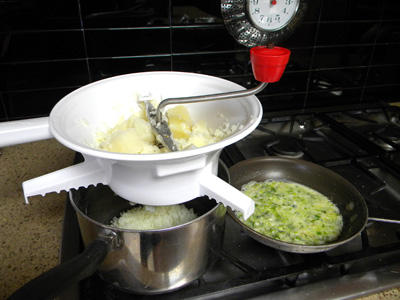
Mashing potatoes into the pot with food mill, with green onion mixture in skillet on the right.
There is a kitchen tool that many of you don’t have, but should invest in… a food mill. I swear by it, there is not better way to make lump-free, perfectly textured mashed potatoes. The food mill consists of three parts: a slanted bottomless bowl, interchangeable disks with holes in various sizes, and a crank with a bent metal blade which mashes the food and pushes it through the disks as you turn it. There are generally three corrugated feet on the bottom of the bowl to old the mill in place on the rim of a pot or pan. The bowl may be plastic, stainless steel or aluminum and the disks and blades are usually made of stainless steel. I prefer the style with the plastic bowl, for easier clean-up. Not only is the food mill used to make perfect mashed potatoes, but also removes the sees when making tomato sauce from cooked tomatoes or to remove pulp from other cooked foods when making a sauce or puree.
Prices range from $20 to $100, I own several (because of the cooking school), but almost always use the $20 plastic model. You can find a food mill at most well-stocked kitchen stores or online.
[Read more →]


October 4, 2009 No Comments
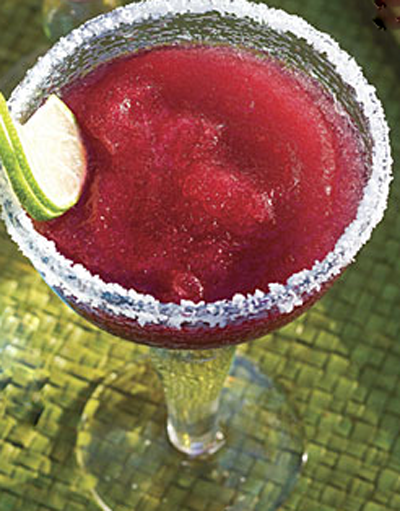
think pink – pomegranate margaritas
It’s Saturday and Dave and I are at NAU in Flagstaff with our freshman, Connor, enjoying “Parents’ Weekend”. Wishing you a wonderful weekend. Why don’t you have a couple of friends over and enjoy this fun and tasty drink?
October 3, 2009 No Comments
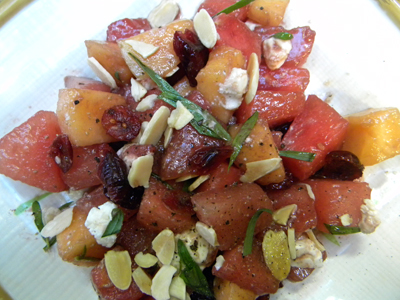
seedless watermelon, lunch and learn
Ah, the joy of seedless watermelons! It may be fun to eat a slice of watermelon outside in the summer sun and spit out the seeds, even having contests to see whose seeds will “go the distance”… but cooking with watermelons with all those mature black seeds, is no fun at all! Seedless watermelons were developed some 40 to 50 years ago, but it’s only been in the last decade or so that they have become a staple in the grocery stores. Seedless watermelons still have white seed coats, which is where the seed did not mature and are fine to swallow while eating. For a more in-depth description and scientific look at seedless watermelons and to answer the question everyone asks, “how do they grow seedless watermelons without a seed?” go to this link – very interesting and informative. While you’re reading and learning, enjoy this refreshing melon salad for lunch (or dinner). The “lunch and learn” in the title is a happy memory of when I was a room mom in my kids’ grade school days and parents would come in at lunchtime and read to the kids in small groups while we all ate out sack lunches… good times!
October 2, 2009 No Comments
pomegranate – another super food
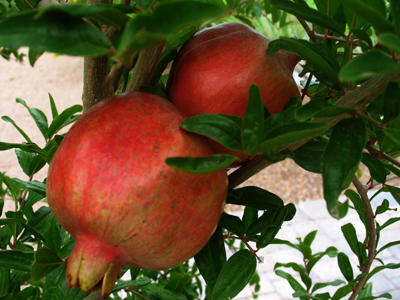
Pom tree in my backyard
It’s pomegranate season and I love pomegranates! They are beautiful and delicious. Great eaten straight out of the hand, or seed and juice to use in recipes, and pretty to dry and use in floral, household, and holiday decor.
Plus pomegranates are a “Super Food”. A single pomegranate or 1/2 cup of its juice provides 40% of an adult’s recommended daily allowance of vitamin C and is a rich source of folic acid and vitamins A and E. One pomegranate also contains three times the antioxidant properties of red wine or green tea.
Researchers report that the pomegranate’s antioxidants can keep bad LDL cholesterol from oxidizing (American Journal of Clinical Nutrition, May 2000). In addition, pomegranate juice, like aspirin, can help keep blood platelets from clumping together to form unwanted clots. Researchers have found that eight ounces of pomegranate juice daily for three months improved the amount of oxygen getting to the heart muscle of patients with coronary heart disease (American Journal of the College of Cardiology, Sept. 2005).
To juice a pomegranate, cut it in half (as you would citrus) and juice using a citrus juicer or reamer. Pour mixture through a cheesecloth-lined strainer. One large pomegranate will produce about 1/2 cup of juice.
[Read more →]
October 1, 2009 2 Comments
crusted chicken with mustard sauce
The original recipe is from an article in Bon Appétit from about 10 years ago, and is still a winner! I’ve changed it up a little over the years, I believe the original used Dijon mustard, and feel free to change out the nuts for your favorite, although the pistachios are pretty darn good! My friend, Kathy, uses toasted pumpkin seeds (pepitas) and loves it. The original recipe also had you place the browned chicken directly on a baking sheet. It bakes more evenly and the bottom crust stays crisp, if they are placed on a rack instead, as pictured here. I like to cook chicken this way because it stays moister when browned in a pan and then baked through in the oven. I think you’ll notice a big difference too. I am not even making the sauce today, because I’m going to use the chicken on the main course salad instead, it’s very versatile and makes great cold chicken sandwiches too!
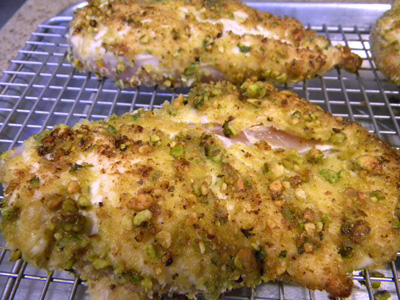
Ready for the oven, notice that the chicken is just browned, not cooked through.
[Read more →]
September 30, 2009 No Comments
fried-green tomato blt’s
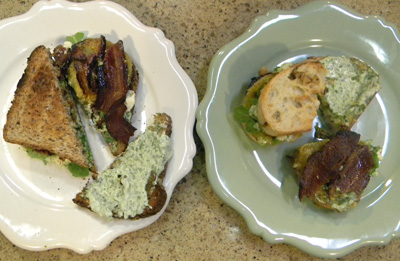
the sandwich on the left is served on whole-grain bread and crusty homemade bread on the right – equally delicious!
Two fortuitous events happened a few minutes apart today to bring about the creation of this recipe. First, I discovered a pound of hickory smoked bacon in my freezer from The Pork Shop. Next, my dad dropped by with a bag of green and ripe tomatoes given to him by my cousin Diane, who has a big garden. I’ll have no problem using up all the lovely ripe red tomatoes, but what to make with those green tomatoes? Well, fried green tomatoes, of course!
Barbara Fenzl, Kim Howard, and I took a “field trip” in late spring to the Queen Creek Olive Mill and The Pork Shop, two fabulous places that are more than worth the 100-mile round- trip from my house! And that is saying something! They are both located in Queen Creek, Arizona, and only about 2 miles from each other, so local foodies, arrange your own “field trip” at lunchtime and thank me later. Go to the Queen Creek Olive Mill website for directions, hours, and tour times. The Pork shop is located at 3359 E Combs Road, Queen Creek Arizona. Call them at 480-987-0101 for information or hours. (since writing this post, The Pork Shop has created a website, check it out HERE.)
[Read more →]
September 29, 2009 No Comments
teriyaki steak salad
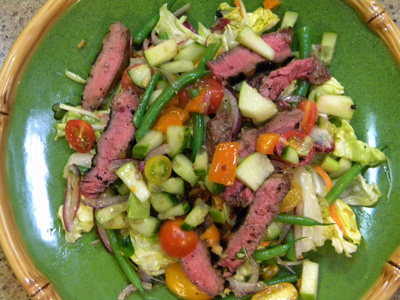
My friend of more than 17 years, Lorie, was in town this weekend from California. I decided on a light and refreshing salad and an Asian theme. We had store-bought sushi for appetizers and green tea martinis. The sushi was a hit… not so much the drinks. Luckily, Lorie brought a bottle of champagne, so we switched to the bubbly after each drinking about half our mar“tea”nies. Oh well, it was worth a try. For dessert – a tart lemon sorbet and thin ginger cookies -are both store-bought. It made for an easy and relaxing meal, leaving plenty of time to catch up and reminisce.
[Read more →]
September 28, 2009 3 Comments
quinoa – a super food
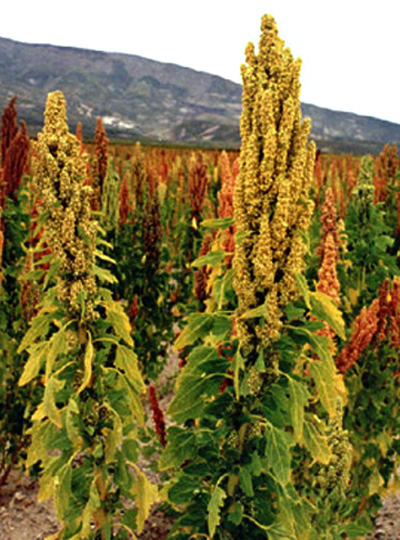
Quinoa plants
Quinoa (pronounced: kinwa), is considered to be a “Super Food” and for good reason, it is high in protein coming in at 13 to 20 percent, making it an excellent choice for vegetarians and vegans. Quinoa is most commonly considered a grain but is actually a seed that is a relative of leafy green vegetables like spinach and Swiss chard. It has a light fluffy texture and nutty taste. Quinoa is a recently rediscovered ancient “grain” once considered “the gold of the Incas.” While relatively new to the United States, quinoa has been cultivated in the Andean mountain regions of Peru, Chile, and Bolivia for over 5,000 years, and it has long been a staple food in the diets of the native Indians. The Incas considered it a sacred food and referred to it as the “mother seed.”
Unlike wheat or rice, which are low in lysine, quinoa contains a balanced set of essential amino acids, making it a complete protein source. It is a good source of fiber and phosphorus and is high in magnesium and iron. It is wheat and gluten-free and easy to digest. On top of all the great news, quinoa is easy to cook. So simmer up a few cups, store it in the fridge and add it to soups, salads, or just serve as a quick side dish, as you would rice.
[Read more →]
September 27, 2009 3 Comments
lots of pancetta plus a little pork
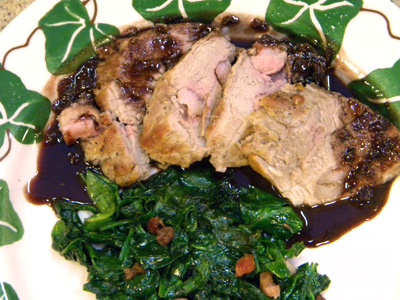
I was at Costco the other day (what’s new?) and was shopping for the “Tucson Roommate Dinner” when I spotted a new item – a huge roll of pancetta. It was just too gorgeous and I couldn’t resist. Now I have to think of dishes to make with my 2 pounds! Pancetta is an Italian bacon that is cured with salt, pepper, and other spices. It is dried for about three months but is not usually smoked. It comes from the pork belly only instead of the sides and belly of the pig, as American bacon does. It is sold in either thin slices or in a roll. Each region of Italy produces its own type of pancetta and in Corsica, it is considered a regional flavor. Since I really don’t want to have pancetta for dinner every night for two weeks, I will be freezing the excess. To do so, I will cut it into 1/2-inch pieces (each about 4 ounces) wrap each tightly in plastic wrap, then in foil, place all pieces in a freezer zip-lock; label with the contents and date, and freeze.
This recipe is pork with more pork. Pork tenderloin with little bits of pancetta inserted inside. The silver skin needs to be removed from the tenderloin, if you need instruction, please see the Tip Index under pages, to the left. The sauce uses a reduced beef broth. Be careful when reducing the broth. It seems to take a long time at first, but once it is reduced by half, the next reduction of half again goes quickly. When reducing a liquid like this, keep a glass measuring cup next to the stove and when you think you’re getting close to the correct amount, just pour the liquid from the pan into the measuring cup. Keep checking every couple of minutes near the end so you don’t go too far. If you happen to reduce it too much, just add water to correct it.
[Read more →]
September 26, 2009 No Comments
key to the cure
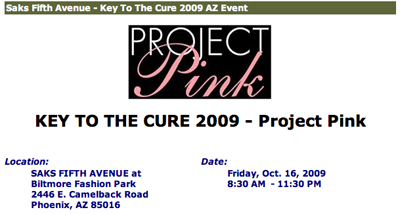
Key To The Cure 2009
In October 2006, I co-chaired Key To The Cure. It is an event that is near and dear to my heart. The proceeds benefit women’s cancer charities. This year, two of my darling friends, Kathy Brown and Cathy Keenan are co-chairing.
You may recall that last week I was making dishes for an addressing brunch, those were for this very event. A picture of the buffet is below. Remember, October is Breast Cancer Awareness Month, so fight back by being mindful of your own breast health, donating to a breast cancer organization, or walking in the Race for the Cure. There is so much we can do, even if it is just being grateful for those in our lives who are survivors by telling them how much we love them or remembering those who have passed. And thank you Kathy and Cathy for taking on this wonderful event! xoxo
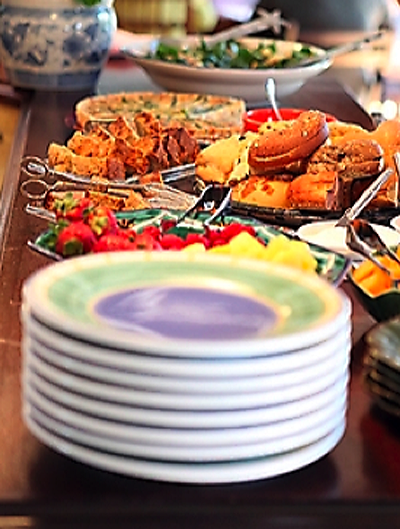
Key to the Cure Addressing Brunch Buffet
September 25, 2009 3 Comments